
We built a tracker for the post-quantum transition
Six in ten HTTPS requests to Cloudflare already use post-quantum key agreement, and the IETF's post-quantum pipeline has nearly quadrupled in two years. The PQC Tracker shows where the transition stands, which ideas are gaining ground and who is behind them. It is free with a Google or GitHub account.
A large enough quantum computer would break the public-key cryptography that protects most of the internet today: RSA, elliptic-curve Diffie-Hellman and the signatures built on them. The replacement is no longer a plan. NIST published its first post-quantum standards, ML-KEM, ML-DSA and SLH-DSA, in August 2024, and has proposed retiring the vulnerable algorithms by 2035. The IETF is fitting the new schemes into TLS, certificates and the other protocols the internet runs on. Browsers, servers and chips are shipping with them.
The transition is happening in many places at once: in research papers, in standards bodies, on mailing lists, in patent filings and in products. Each of those moves at its own pace and speaks its own language, and no one place shows them together. We wanted that place for our own work, so we built it. The PQC Tracker is now open at pqc.cipher.law.
As of October 16, 2026, it follows 336 ideas, 338 IETF drafts, 716 organizations and 2,166 people. Here is some of what it shows.
The switch is already under way
The clearest sign that the transition is real is in live traffic. In the week of October 12, 2026, about 60% of HTTPS requests reaching Cloudflare used post-quantum key agreement, up from 39% a year earlier. Most of that is the hybrid X25519MLKEM768 key exchange that current browsers offer by default.
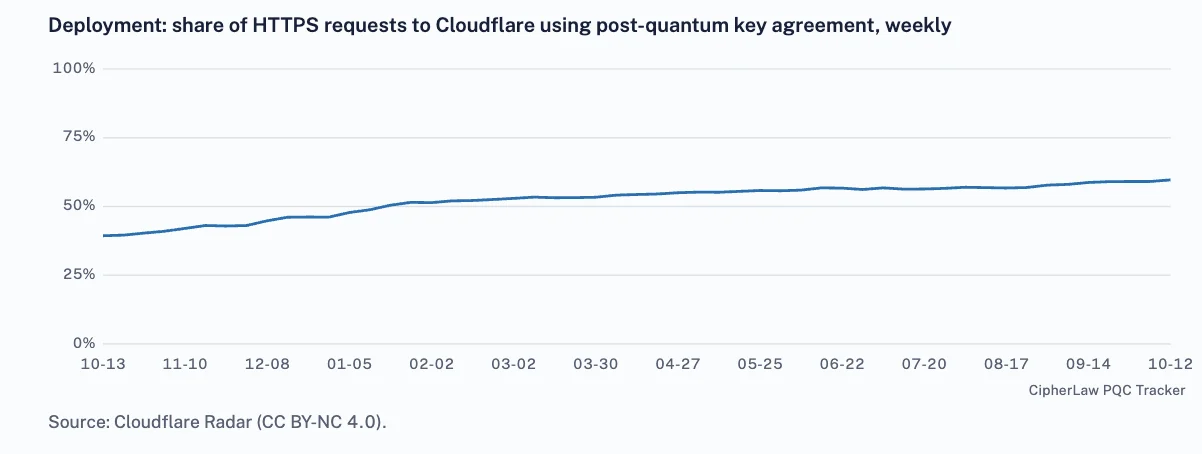
Key agreement is the easy half. Certificates and signatures, the other half of the problem, are much further behind, and that is where most of the open standards work now sits.
The standards pipeline is filling up fast
At the start of 2024 there were 35 active individual Internet-Drafts on post-quantum work. Today there are 130. Working-group drafts rose from 12 to 31 over the same period, and published RFCs from 7 to 28.
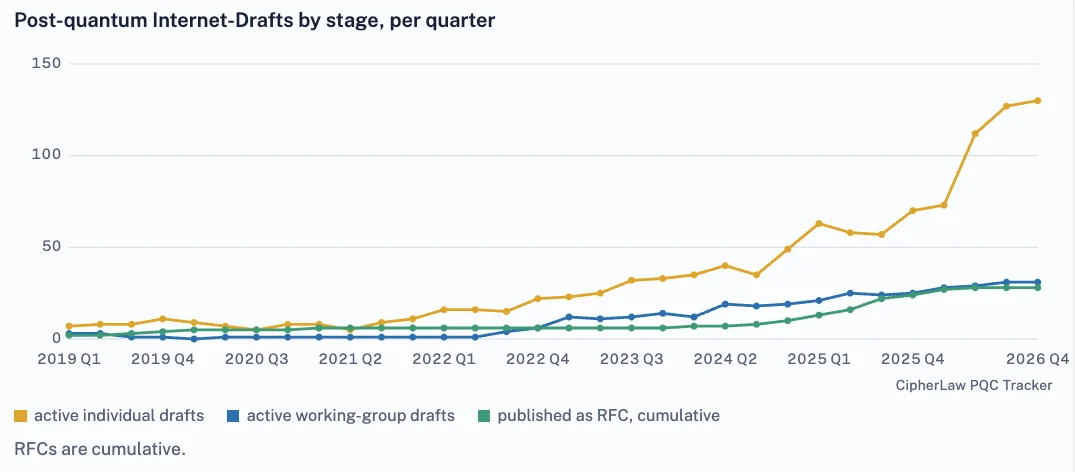
The gap between the two lines is the interesting part. Most proposals never become standards. Of the 108 individual drafts first posted before October 2024, 45 expired without being adopted, 22 were adopted by a working group and 28 were published as RFCs. For the drafts that were adopted, the median wait was about ten months. If your product, your patent position or your client’s roadmap depends on one of those 130 individual drafts, its odds and its timeline are worth knowing.
Where the work actually sits
The field has grown fast: 802 papers and draft revisions in the last six months, against 443 in the same period a year earlier. When everything is growing, raw counts mislead. The tracker shows each part of the field against the field as a whole, so you can see which parts are gaining share and which are only riding the tide.
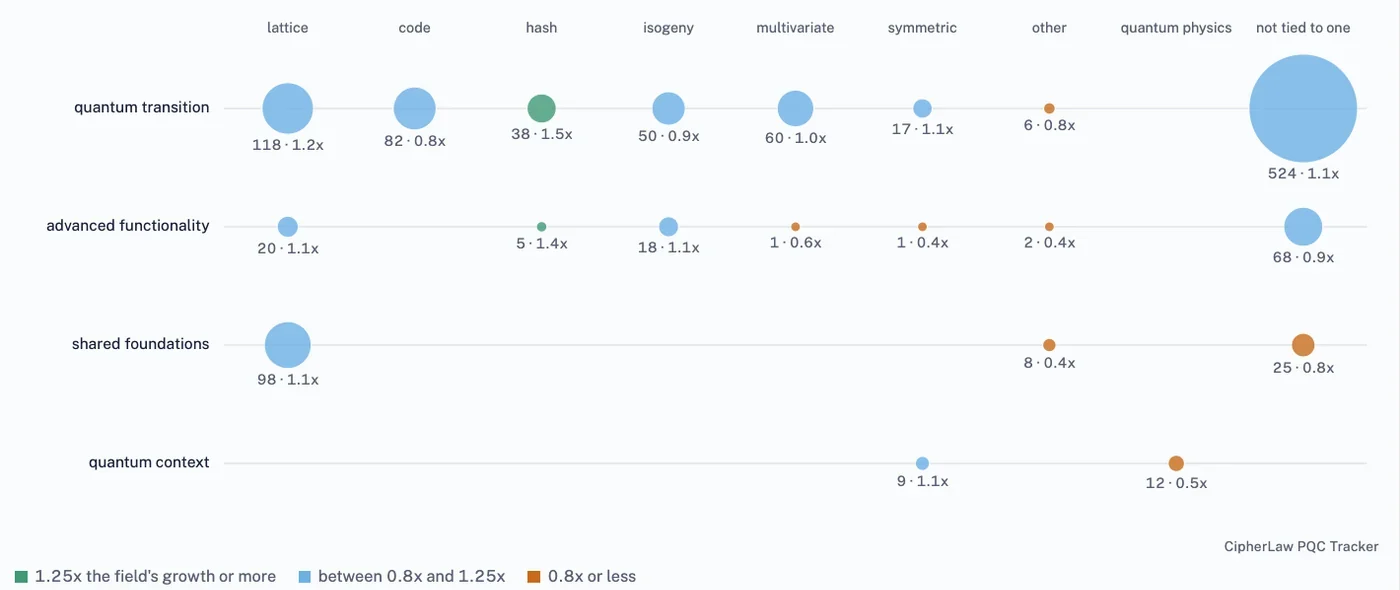
Three things stand out:
- Most of the work is no longer about choosing algorithms. The largest circle by far, 524 items, is transition work that is not tied to any one family of mathematics: protocol integration, migration, hybrids, implementation and deployment. The question has moved from which scheme to how to put it everywhere.
- Lattices still dominate the mathematics. Lattice-based transition work (118 items) and lattice foundations (98) remain the largest single-family areas, as you would expect with ML-KEM and ML-DSA both lattice schemes.
- Hash-based signatures are the fastest-growing family, at 1.5 times the field’s growth. Their security rests on the hash functions we already trust, which makes them attractive wherever signatures must last for decades, such as firmware and roots of trust.
What is heating up
The activity map lays out every idea with enough work behind it, quarter by quarter. Sorted by how fast each is rising, it reads like a list of the field’s next arguments.
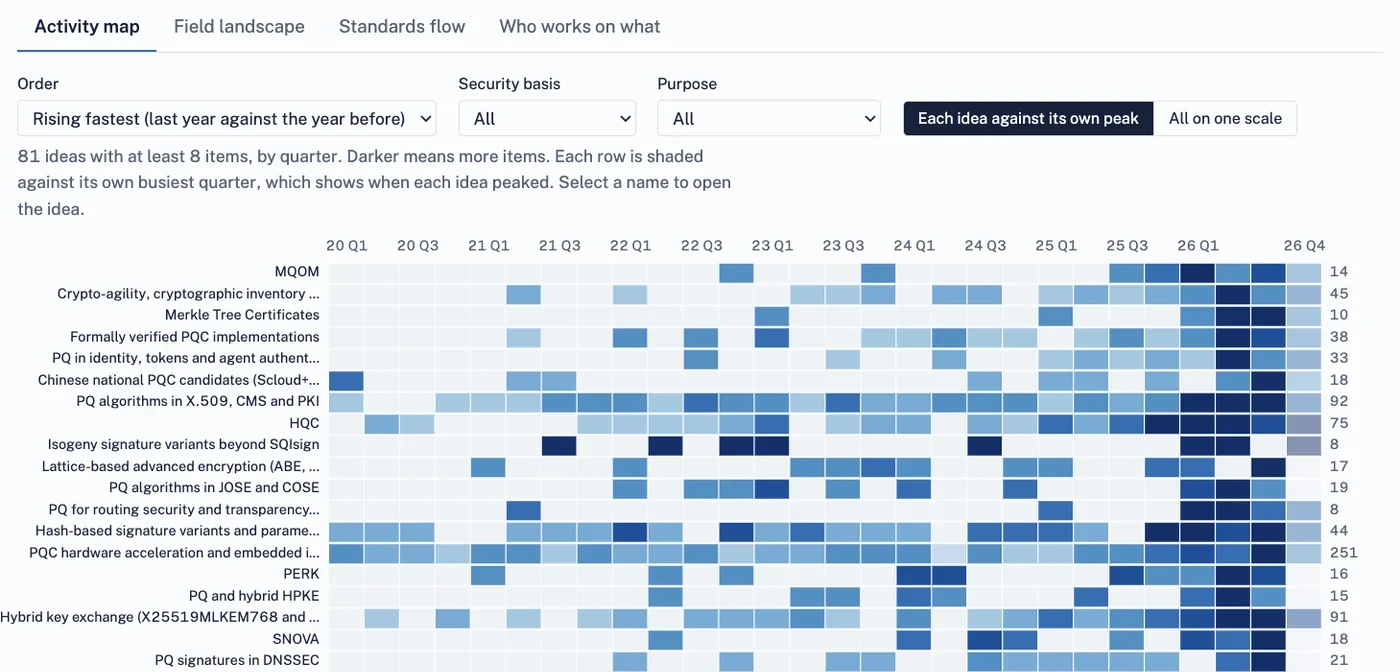
Near the top: MQOM, one of nine signature candidates NIST advanced to the third round of its additional-signatures process in May 2026; crypto-agility and cryptographic inventory, the unglamorous work of finding every place an organization uses vulnerable cryptography; Merkle Tree Certificates, a proposal to shrink the cost of post-quantum certificates on the web; formally verified implementations; and post-quantum methods for identity, tokens and agent authentication. Several of these barely existed two years ago.
Every name on the map opens that idea’s own page, with its trend, the organizations and people working on it, its drafts and standards status, and the most recent work.
Where the arguments happen
Standards are settled in public, on mailing lists, and the tracker shows where that discussion is concentrated.
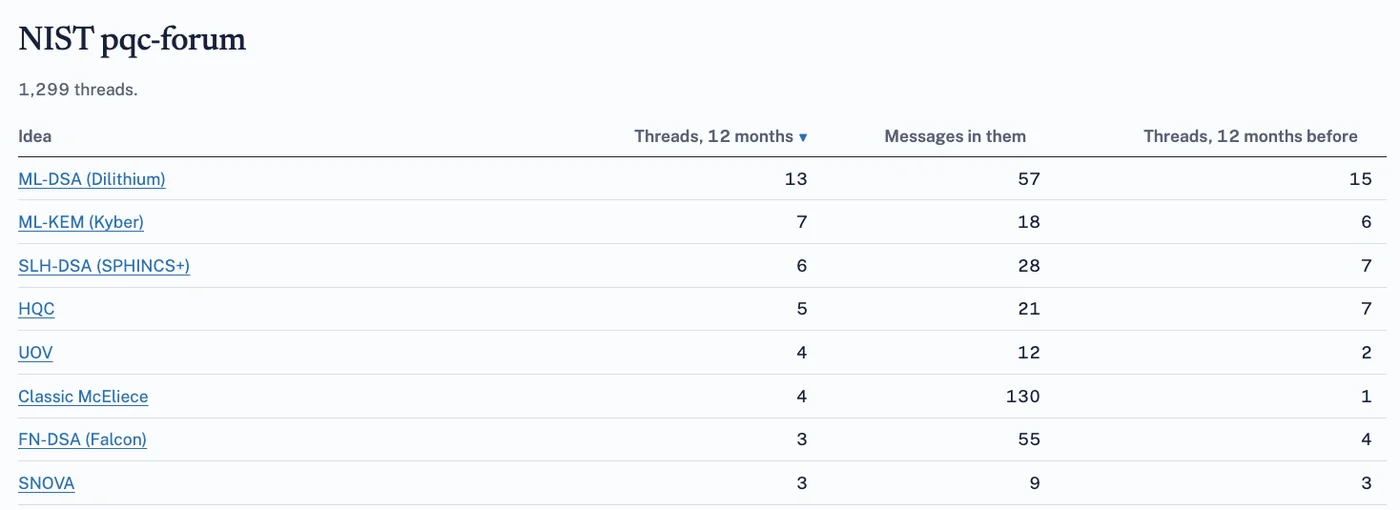
ML-DSA drew the most threads in the last year. Classic McEliece drew only four, but they ran to 130 messages: a few long, contested debates rather than routine questions. FN-DSA, the Falcon-based signature still awaiting its final standard, shows the same pattern. Counts like these are an early signal of where a standard is still in play.
Everything else
The maps are a way in. Behind them:
- Reports on each integration area: TLS, PKI and certificates, SSH, IPsec and VPNs, DNSSEC, secure messaging, email, hardware, blockchains and telecommunications. Each opens with the answer to one question, where is this area heading and who is driving it, and then shows the evidence. Any two areas can be compared side by side.
- A page for every idea, organization, person and draft, linked to one another, so you can follow a name from a paper to its authors to their other work.
- Standards bodies: the IETF pipeline, NIST’s status pages, IANA code points, ISO and ETSI work items, and the most discussed drafts.
- Patents: disclosures filed with the IETF on post-quantum drafts and the patent statements filed with NIST’s post-quantum process.
- The market: deployment, validated implementations, the libraries developers depend on, hiring, and federal demand.
- Public discussion on Bluesky, Mastodon and X, which tends to run days or weeks ahead of citations.
Every view can be shared as a link that reopens exactly what you were looking at.
Who it is for
We built it for our own practice. Drafting claims, reviewing a portfolio or assessing a target in this field starts with knowing what is new, who got there first and what the standards will require. A claim drafted around a scheme that is about to be revised, or a diligence memo that misses which drafts a company’s product depends on, is a costly mistake.
We expect it to be just as useful to engineers deciding what to build on, to people working in the standards bodies, to companies planning their own migration, and to investors trying to tell which ideas will last.
Try it
The tracker is free. Sign in with a Google or GitHub account at pqc.cipher.law. We welcome comments and corrections at admin@cipher.law.